Small Frame, Rich Milk
Jersey
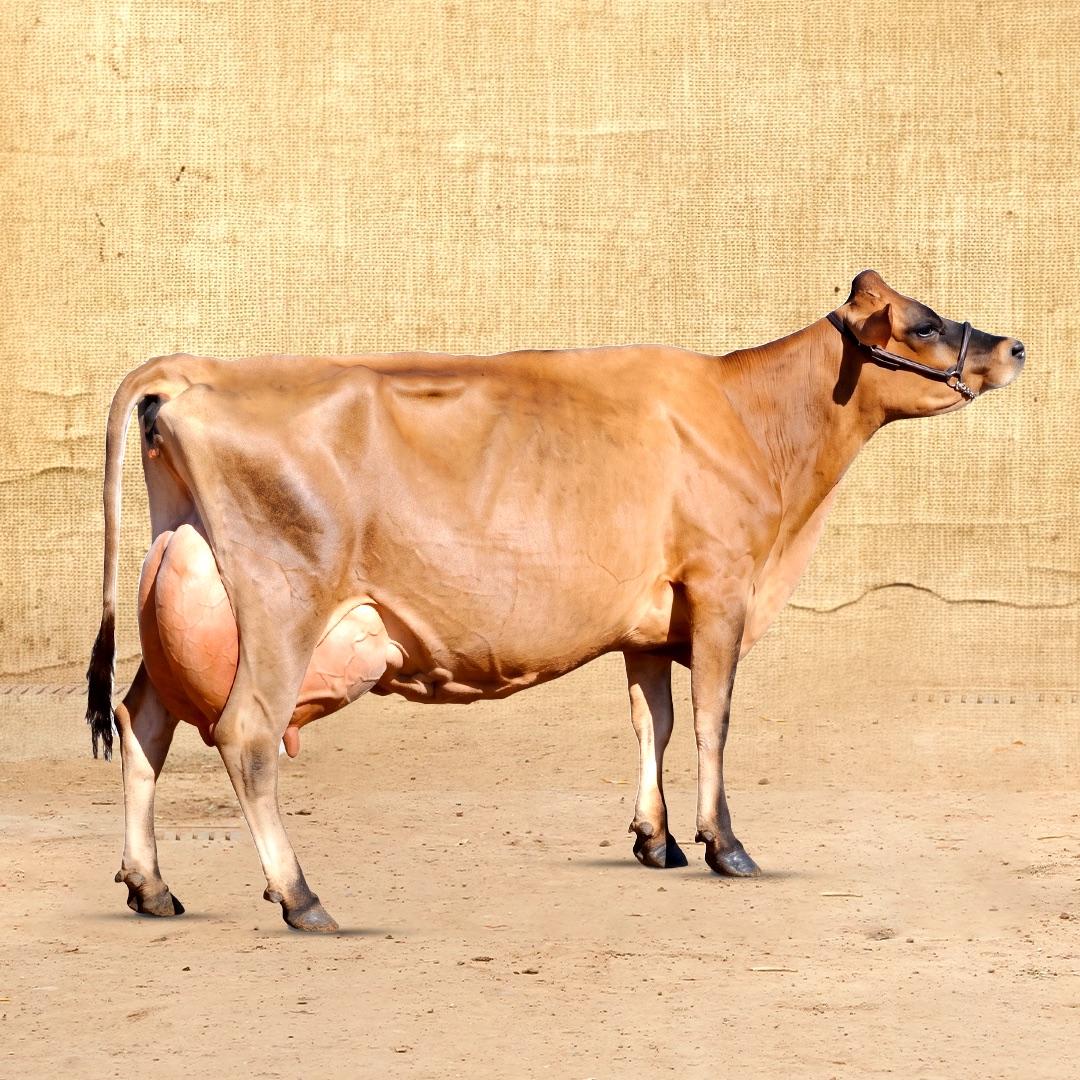
Jersey is the small dairy breed from the island of Jersey, prized for milk rich in fat and protein. In India it is mostly met as the Jersey cross: crossbred Jersey makes up about half of the country’s exotic and crossbred cattle.
Cattle · Bos taurus (European dairy)
- Rich milk
- Small, compact frame
- More heat-tolerant than Holstein
At a glance
Two kinds of number, side by side: what this breed typically gives under good management, and the national breed average recorded by ICAR-NBAGR across every kind of farm.
- Litres a day, good management
- 8–12
- Hebbevu’s typical range
- Per 305-day lactation, Jersey crosses in India
- 2,394 kg
- 75,627 crossbred cows, Tamil Nadu
- Milk fat
- 4.5–5%
- Cow body weight
- 410–480 kg
Purebred Jerseys on the hot Tamil Nadu plains averaged about 1,490 kg per 305 days, far below herds at high altitude. Recorded US Jerseys, by contrast, average over 9,000 kg a lactation.
Getting to know the Jersey
Where it comes from
The Island of Jersey in the Channel Islands. The island kept its herd closed to imports for over 200 years, until 2008.
Named after the island. In India it is usually met as the Jersey crossbred.
How to recognise it
- Coat
- Usually reddish fawn.
- Build
- The smallest dairy breed: compact and angular, with a dished forehead.
Size
- Cow
- 410–480 kg
Average adult size, ICAR-NBAGR.
Strengths in the field
The exotic breed most used in Indian crossbreeding
Built for
- Handles heat better than Holstein Friesian: in a US study on one farm, Jersey yield held up where Holstein yield fell
- Performs best in cooler, high-altitude areas; much lower yields on hot plains
- Gives less milk by volume than Holstein, but richer in fat
Used for
- Milk, especially for butter, ghee and cheese
- Crossbreeding with non-descript cattle, keeping exotic inheritance to about half
Around the world
From one island to over 80 countries
Jerseys are now found in at least 82 countries. In the United States, about 1.8 million Jerseys make up some 14% of dairy cows.
In India, Jersey became the backbone of crossbreeding. In Tamil Nadu, Jersey crossbreds produce about 90% of the state’s milk, and in Kerala, Jersey bulls helped create the Sunandini breed.
- United States
- Denmark
- Japan
- Mexico
Breed records
The published facts in one place. Averages, not guarantees. Individual animals and well-run herds can do far better.
| Record | Jersey |
|---|---|
| Species | Cattle · Bos taurus (European dairy) |
| Native tract | The Island of Jersey in the Channel Islands. The island kept its herd closed to imports for over 200 years, until 2008. |
| Typical daily yield, good management | 8–12 litres/day |
| Per 305-day lactation, Jersey crosses in India | 2,394 kg |
| Milk fat | 4.5–5% |
| Milk type | Mixed, not reliably A2 |
| Age at first calving | 25–30 months |
| Calving interval | 13–14 months |
| Cow weight | 410–480 kg |
| Population | Crossbred Jersey is about half of India’s exotic and crossbred cattle (20th Livestock Census breed report). |
What to know before you choose
Expect less on hot plains
A purebred Jersey on a hot Tamil Nadu farm gave about 1,490 kg per 305 days, far below brochure figures. Indian policy favours crosses of up to about half Jersey.
Not reliably A2
None of the Jersey crossbred cows tested in one Tamil Nadu study were A2A2. If your market pays for A2 milk, ask for genotyped A2A2 semen or embryos, or choose an indigenous breed.
Choose it for richness, not litres
Jerseys cope with heat better than Holsteins but give less milk by volume. The case for them is a smaller animal and richer milk.
Is this the right breed for you?
Choosing the right breed is the foundation of a successful dairy operation.
- 01How hot and dry does it get on your land?
- 02Can you hold feed quality through a bad season?
- 03Does your market pay a premium for A2 milk?
- 04How close is your nearest competent vet?
Sources and other breeds
Sources (10)
- TNAU Agritech: exotic cattle breeds
- American Jersey Cattle Association
- Frontiers in Genetics 2020: the Island Jersey
- Thiruvenkadan: purebred Jersey on the Tamil Nadu plains
- Kasiviswanathan et al. 2024, Animals: Jersey crossbreds in Tamil Nadu
- Sodhi et al. 2012, Indian Journal of Animal Sciences: A1/A2 β-casein in Indian cattle
- Kathiravan et al. 2023, Indian Journal of Animal Research: A1/A2 in cattle and buffalo
- Smith et al. 2013, Journal of Dairy Science: Jersey and Holstein under heat stress
- FAO: the Sunandini breed of Kerala
- Krishi Jagran: breed-wise report, 20th Livestock Census
- National averages come from the ICAR-NBAGR breed registry and the NDDB Dairy Knowledge Portal.
Interested in Jersey genetics?
Tell us about your herd and we will help you decide whether this breed, and IVF, makes sense for you.